Cost per approved creative equals total batch production cost divided by final approved content pieces. Include cash expenses and allocated human work, including rejected drafts and revisions. Approval and publication are different milestones: an approved piece does not need to be live to count here.
Calculate your batch.
The sample calculation.
The illustrative batch costs 300 currency units in external charges plus six human hours at 40 units per hour. Its total is 540. Twelve candidate pieces were produced, of which nine were approved. That is 60 units per approved creative, compared with 45 per candidate produced.
The final approval share is nine divided by twelve, or 75%. This is not a first-pass approval rate: the nine approved pieces may have needed revisions. It also says nothing about sales performance. These are hypothetical inputs, not an Aitoma customer result.
View the worked example as an infographic
A hypothetical USD batch, not measured customer results. This static illustration does not change with the calculator inputs.
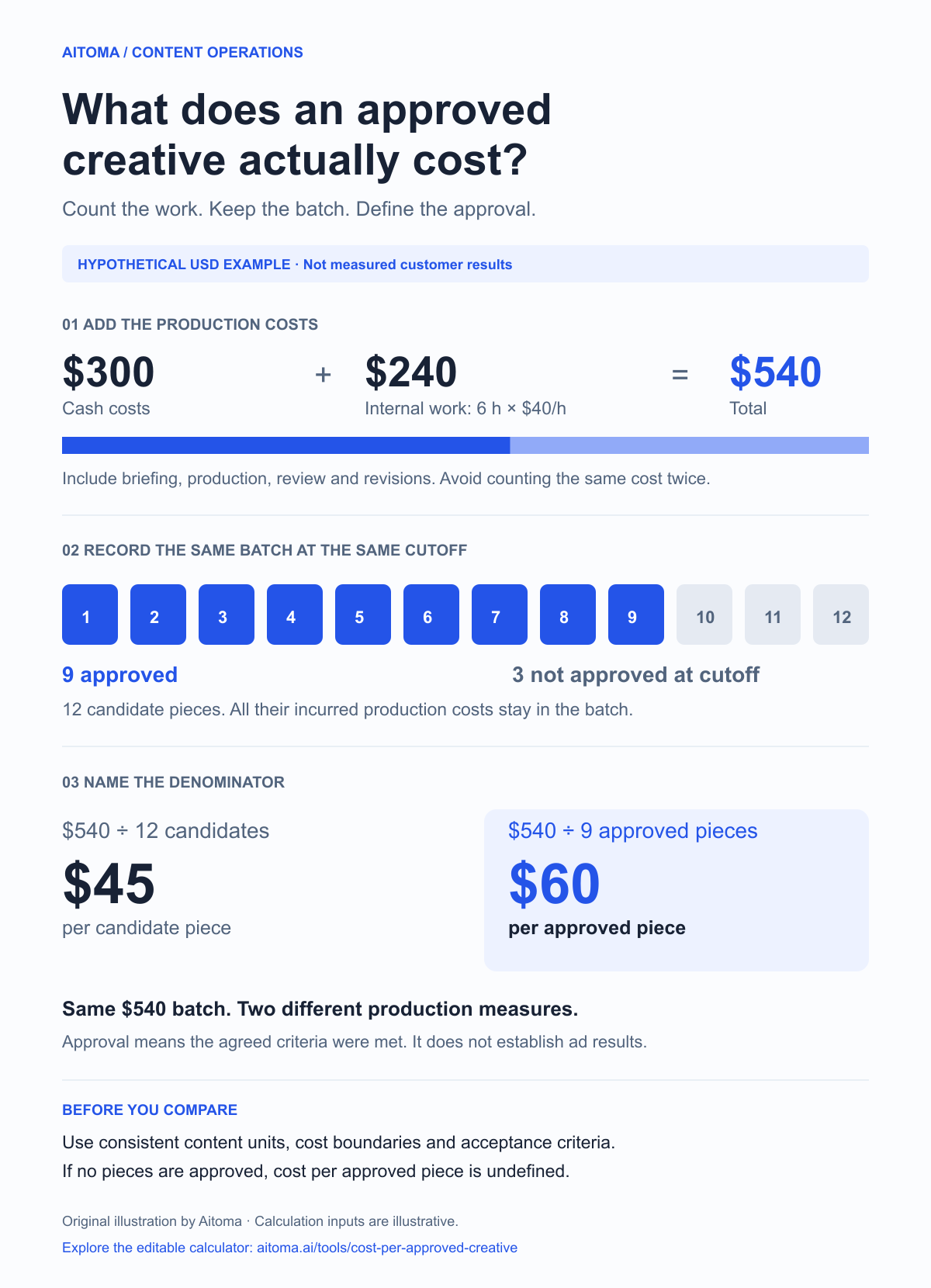
Download the infographic (PNG, 215 KB) · Download the text explanation
You may share this graphic unchanged with attribution and a link to this calculator. Keep the hypothetical-example label visible.
Keep approved, published, and successful separate.
| Milestone | What belongs in the count |
|---|---|
| Produced | Distinct candidate pieces submitted for review, using the unit agreed in the brief. |
| Approved | Pieces accepted against the agreed criteria, whether or not they have been scheduled. |
| Published | Approved pieces that actually went live. Report this as a separate count. |
| Successful | Pieces that met a defined campaign objective. Approval alone cannot establish this. |
If nine pieces are approved but only six are published this month, the sample production cost per approved piece remains 540 ÷ 9 = 60. Dividing the same cost by six gives 90 per published piece, a different metric. Label its time period and cost boundary rather than replacing one denominator with the other.
Measure a completed batch when possible. If reviews are still open, record the cutoff date and mark the result provisional. When nothing is approved, cost per approved piece is undefined, not zero.
Work through an extra revision round.
Start with the same hypothetical batch: 540 total cost and nine approved pieces from twelve candidates. Suppose another round costs 60 in external charges plus two internal hours at 40 per hour. The additional cost is 140; the projected total is 680. These are planning assumptions, not observed Aitoma results.
| Assumed result of this round | Projected approvals | Projected cost per approved piece |
|---|---|---|
| No additional pieces accepted | 9 of 12 | 680 ÷ 9 = 75.56 |
| One additional piece accepted | 10 of 12 | 680 ÷ 10 = 68.00 |
| All three remaining pieces accepted | 12 of 12 | 680 ÷ 12 = 56.67 |
With one additional approval, the average rises from 60 to 68 even though the approval share improves. With three additional approvals, the average falls to 56.67. The calculator does not predict which outcome will happen.
A lower average is not sufficient reason to commission more work. Consider the value of the deliverable, whether the defect is fixable, the deadline, and alternative uses of the same effort. Keep the acceptance standard unchanged. Do not mark unusable content approved to improve the percentage.
Use the optional revision section above to compare your own assumptions. It adds costs to the existing batch and limits additional approvals to candidates not already counted as approved. It does not model new concepts or candidates; start a separate batch for those.
Record the work behind each revision.
| Fictional revision record | Time or fee | How it enters the scenario |
|---|---|---|
| Supplier corrects the voiceover | 60 currency units | Additional cash; do not also count the supplier’s hours. |
| Internal reviewer checks product wording | 0.5 hour at 40 | 20 internal cost. |
| Internal editor checks timing and captions | 1 hour at 40 | 40 internal cost. |
| Business reviewer checks the replacement export | 0.5 hour at 40 | 20 internal cost. |
The internal work totals two hours and 80 currency units. Together with the supplier fee, that explains the 140 additional cost. Include the review work even if the revised export is rejected. If participants have different rates, sum their costs and divide by their combined hours to obtain the weighted rate.
Keep asset ID, version, reason for change, fee, reviewer time, and decision in your creative review record. Waiting two days for a reviewer is elapsed time; it is not automatically sixteen hours of labor. Estimate or track active work explicitly.
Download the blank revision cost log to record the inputs. It is a plain worksheet, with no assumed industry rates or automatic financial formulas.
Set the unit before comparing suppliers.
| Decision | How to keep the comparison useful |
|---|---|
| Carousel | Count one complete carousel as one piece if that is the unit in your scope. Do not switch to counting slides when reporting approvals. |
| Revised export | Treat revisions of the same candidate as work on that piece, not extra approved content. |
| Different formats | Separate videos, images, and carousels when their cost or effort differs substantially. |
| Rejected candidates | Keep their production and review cost in the batch total. |
| Still awaiting a decision | Label the result provisional, or measure a completed cohort. |
A batch of twelve simple image ads is not directly comparable with twelve edited videos. Use matched scopes or report the format mix alongside the number. A single average can hide the work that makes one supplier more or less suitable.
Include costs once.
Cash cost can include the supplier invoice, allocated software charges, purchased assets, and other production expenses for this batch. Human time can include briefing, coordination, factual review, edit requests, and final approval. Use an internal hourly cost that makes sense for your planning.
If a supplier invoice already includes their editing labor, do not add those same hours again. Include your team’s separate work. If several people have different rates, calculate their total labor cost separately and use a weighted average rate in the form.
This tool excludes ad spend and resulting revenue. It measures production cost, not customer acquisition cost or return on investment. Any estimate of savings needs a comparable previous process and the same cost boundaries.
Use the result to find the next bottleneck.
If many outputs are rejected because the brief lacked current product references, improve the input package. If approved pieces require repeated factual corrections, add a source check before generation. If most cost comes from coordination, consolidate reviewer feedback.
A higher approval share can lower cost per accepted piece while other conditions stay equal, but the goal is useful content. Lowering the acceptance standard to improve the percentage defeats the purpose. Record why a piece failed and whether the next batch fixed that issue.